
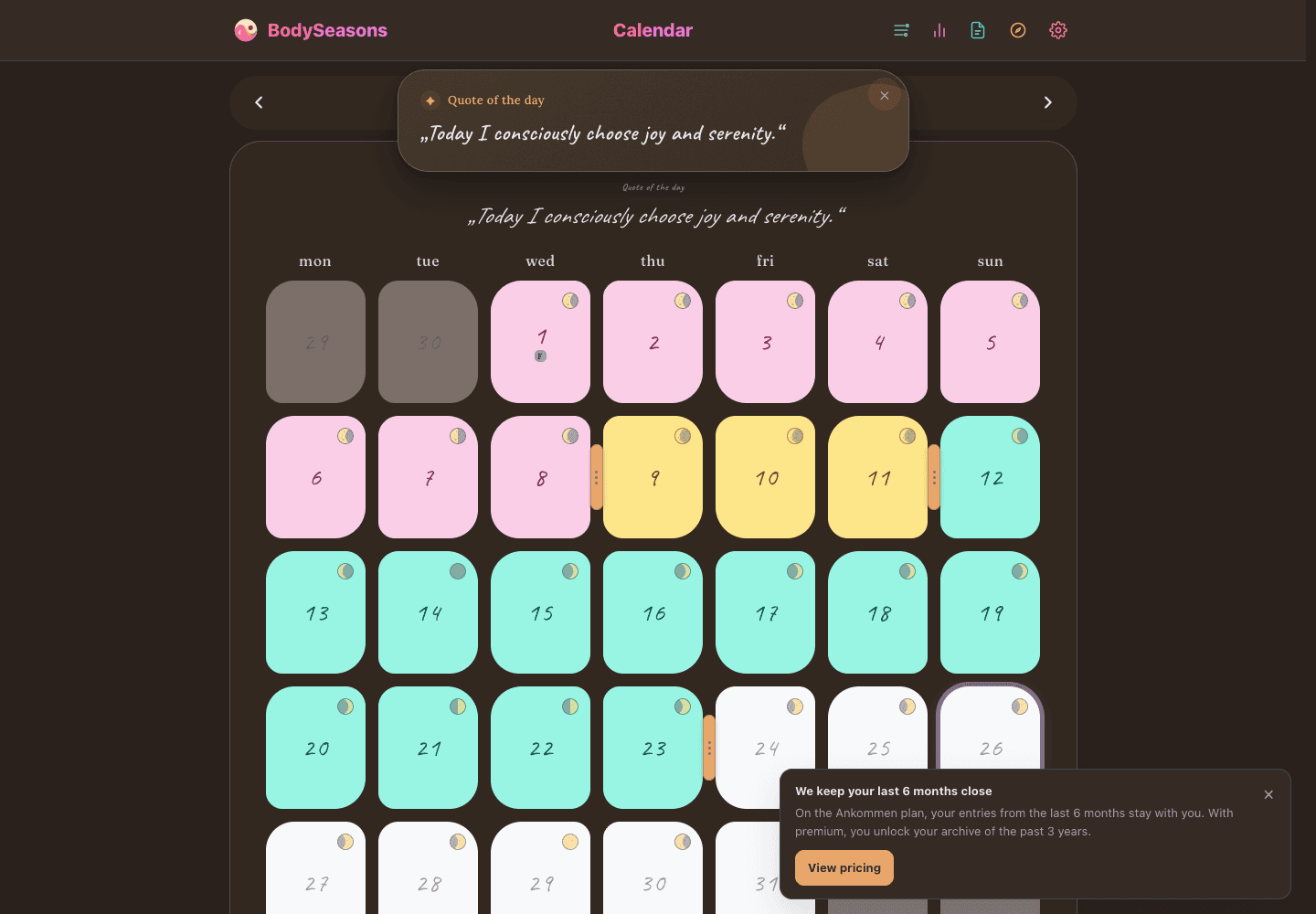
Building a health app is not only a matter of adding more data points, charts and recommendations. When people document personal body data, the responsibility of the product changes. Every sentence can create reassurance, pressure or the false impression of a medical conclusion.
BodySeasons grew from a personal need. The application helps users document cycle, symptoms, mood, sleep, nutrition and other everyday influences in a structured way. It connects entries into statistics and personal reports.
The boundary matters: BodySeasons supports documentation and orientation. It does not provide diagnoses and is not a substitute for medical advice or treatment.
This field report does not describe a medical method. It explains product and software decisions we made while building a sensitive tracking product.
1. An insight must not sound like a verdict
A chart looks objective. It still reflects only the data a person entered and the period the application knows. Missing entries, changing circumstances and individual differences remain.
We therefore distinguish observation from assessment. The application can show how a user's own entries are distributed over time. It must not turn that pattern into a diagnosis.
This boundary affects more than a legal note at the bottom of a page. It changes headings, empty states, explanations and the language of personal reports. "Your entries show" is more honest than presenting a certain cause.
2. More tracking is not automatically better
A tracking product can quickly become a daily obligation. Every additional question increases both the amount of data and the burden on the user. People need to be able to choose which areas are relevant to them.
BodySeasons separates tracking areas and settings. The interface is designed to support a light daily check-in instead of confronting users with a complete medical history.
The product rule is simple: a data field needs a visible purpose. If we cannot explain how an input helps the user, it should not be collected.
3. Sensitive data needs understandable ownership
With body data, writing "secure" somewhere is not enough. Users need to understand when information is stored, how cloud synchronization works and which services are involved.
BodySeasons separates the user interface, product logic and selected supporting services. It uses horizOn for authentication and cloud storage. Supporting services have bounded responsibilities. This separation helps keep access and responsibility small.
The public BodySeasons security page describes safeguards, limitations and contact paths. That page is part of the product, not documentation saved for a future audit.
4. Personal reports need visible limits
Many daily entries can create a useful overview. It is also easy to suggest more certainty than the data supports through language and visual design.
We use several guardrails:
- reports refer to the user's documented data,
- guidance is described as orientation,
- medical boundaries remain visible next to the statement,
- entries can support a conversation, not become a diagnosis,
- uncertainty is not hidden behind a polished percentage.
This is also a design problem. Color, emphasis and order affect whether a message feels supportive or alarming.
5. Localization is more than translation
BodySeasons is available in German and English. Localization includes date formats, routes, search metadata, domain language and the tone of sensitive guidance.
With health-adjacent language, a technically correct but unnatural translation can sound distant, commanding or medically absolute. Important boundaries and explanations are therefore treated as product copy in both languages.
6. A health product needs a cautious knowledge process
General information must remain separate from personal data. Sources can provide orientation, but they do not automatically become an individual recommendation.
BodySeasons uses a curated knowledge model based on carefully reviewed professional sources and guidelines. This is not evidence of medical efficacy. It is a working process for presenting general information with traceable limits.
For software development, that means content needs provenance, a defined scope and a path for revision. Raw knowledge should not flow unchecked into a personalized output.
7. Live operations are part of trust
Sensitive software does not become trustworthy through its first release alone. Dependencies need updates, errors need monitoring, backups need testing and security reports need a response.
The product therefore includes work outside the visible app:
- separate development and production environments,
- controlled releases,
- monitoring and error analysis,
- documented data flows,
- visible security contacts,
- recurring technical and editorial review.
This work rarely appears in a screenshot, but it determines whether an application remains dependable months later.
Lessons for other software products
The lessons from BodySeasons apply beyond health software. Financial products, HR systems and AI assistants also process information that people do not experience as an ordinary dataset.
Three principles transfer well:
- A product boundary should be visible next to the feature.
- Every collected data point needs an understandable purpose.
- Operations, security and content must evolve together.
Visit BodySeasons to see the application, its public methodology and security information. Our products and projects provide more technical and design context.
If you are planning an application with sensitive data, we can clarify which information is actually needed, what the product may responsibly claim and how reliable operations should work. Tell us about the concrete use case.